
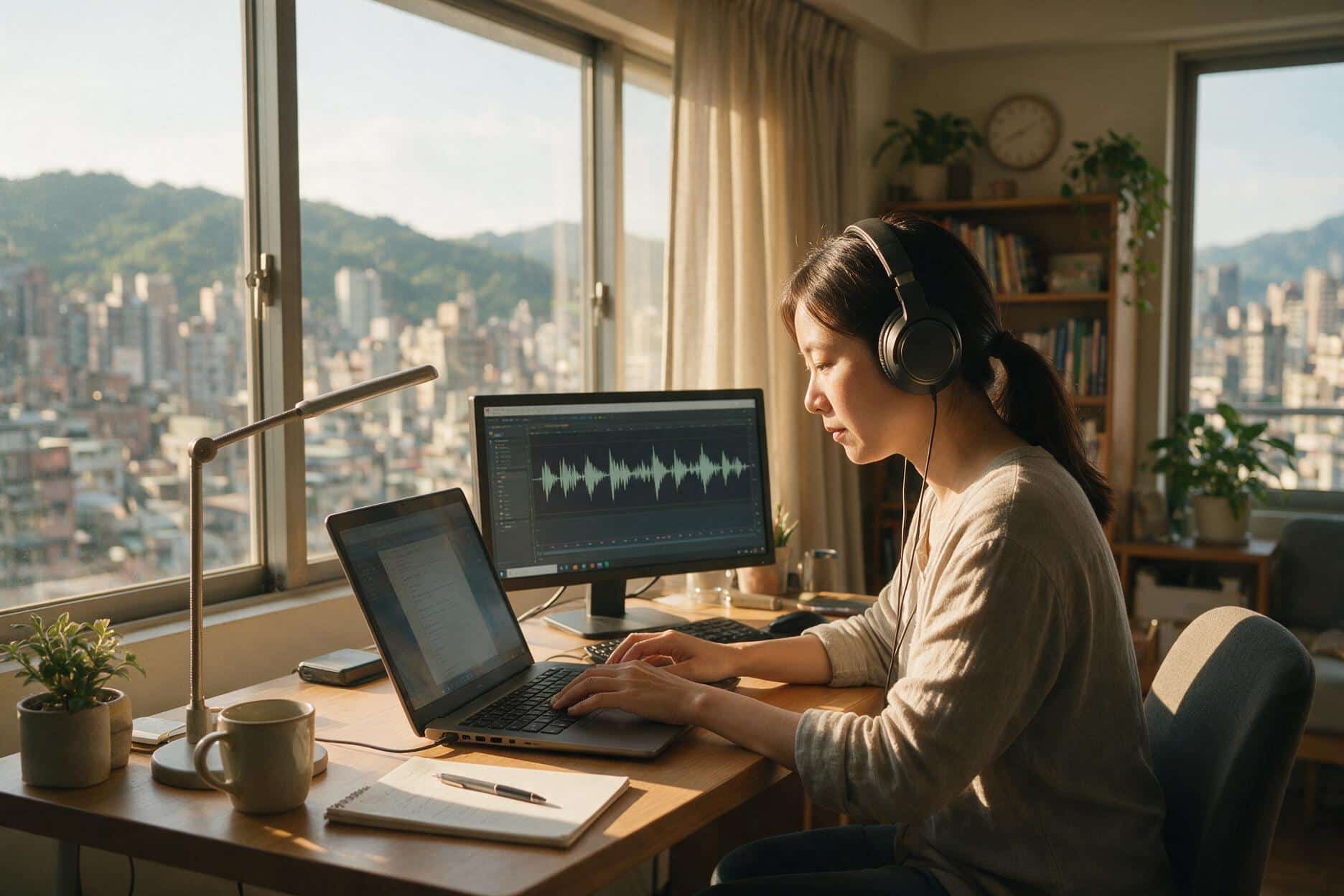
Transcription · Chinese (Traditional)
Traditional Chinese transcription services
Native transcribers for Taiwanese Mandarin and Hong Kong Cantonese — corporate, legal, broadcast, research and market-research audio, written in Traditional Chinese to the standard of the territory it comes from, with Cantonese speech written as a document or as Cantonese, whichever you need.
About Traditional Chinese transcription
Find the right Traditional Chinese transcription for your project
Traditional Chinese is the written form used in Taiwan, Hong Kong and Macao. Ordering a "Traditional Chinese transcript" sounds like one thing; in practice it is at least two, because Taiwan and Hong Kong each maintain their own standard for how characters are written — Taiwan's Ministry of Education table of 4,808 standard forms, Hong Kong's Education Bureau list of 4,762 — and the two disagree on the shape of a noticeable share of everyday characters. Readers in each place recognise the other's forms as foreign.
Hong Kong adds a second decision, because what is spoken there is Cantonese. A Cantonese recording can be written as standard written Chinese — the form of a report, a contract or a news item — or as written Cantonese, with its own characters (嘅、喺、唔、佢) that put the speech on the page as it was said. They are different texts, and which one you need depends entirely on what the transcript is for.
At GoLocalise, we work with native Taiwanese and Hong Kong transcribers — matched to the territory of the recording — and a project manager who settles those decisions at the brief and stays across every step, from speaker identification through to proofreading, time-coding and delivery.

Choose your format
Three ways to transcribe the same recording
The right one depends on what the transcript is for. If you are not sure, tell us the use case and we will recommend it.
Full verbatim
Every wordRecords every spoken detail, including pauses, filler words, repetitions and hesitations, exactly as they occur.
Best for
Legal proceedings, arbitration, research interviews
Edited
Clean readRemoves redundant words and hesitations while keeping the meaning and the speaker's intent fully intact.
Best for
Interviews for publication, broadcast material, content to be translated
Summarised
Key pointsCondenses the discussion into structured key points rather than a full record of the conversation.
Best for
Meeting minutes, focus-group reporting, internal documentation
What's included
What comes with every Traditional Chinese transcript
Territory-correct character forms
Taiwan's MOE standard forms for Taiwanese material, Hong Kong's EDB forms for Hong Kong material. Never one passed off as the other.
Cantonese written to brief
Standard written Chinese for documents, or written Cantonese for research, subtitles and local-market content — agreed first, labelled on the page.
Local punctuation and vocabulary
Taiwan's centred 。 and 「」 quotation marks where they belong, and Taiwanese terms kept rather than replaced with Mainland equivalents.
Timecodes
Stamped at the interval you need — per speaker turn, per paragraph or at fixed intervals.
Speaker identification
Every turn attributed, by name where you supply them or by role where you don't.
Your format
Word, PDF, plain text, Excel or a subtitle-ready file — tell us the next step.
How it works
One project manager, from brief to delivery
A structured workflow, built so accuracy and confidentiality are verified at each stage rather than assumed at the end.
Brief review
We review your audio, the subject matter, any speaker lists and your target output — and confirm the territory and, for Cantonese, the written form you need.
Transcriber assignment
We match your project to a native Taiwanese or Hong Kong transcriber with the right subject expertise.
Transcription
The recording is transcribed in Traditional Chinese to the territory's standard, with speaker labels and timestamps applied as briefed.
Form and punctuation check
A second linguist checks the transcript against the audio and against the character forms and punctuation of the territory.
Delivery
Clean, time-coded transcripts in your chosen format, on budget and on time.
Tell us two things: where the recording is from, and who will read the transcript. Between them they decide the character forms, the punctuation and — for Hong Kong — whether the page carries standard written Chinese or the Cantonese that was actually spoken.
Who we work with
Industries that rely on Traditional Chinese transcription
Taiwan and Hong Kong are finance, technology and media hubs with distinct regulatory and cultural environments. These are the briefs we see most.
Finance & corporate
Board meetings, analyst calls and internal communications for companies in Hong Kong and Taipei.
Legal & arbitration
Hearings, witness statements and arbitration recordings, transcribed verbatim to the tribunal's format.
Technology & manufacturing
Supplier meetings, engineering reviews and product research across Taiwan's technology sector.
Market research
Focus groups and interviews in Taiwanese Mandarin and Hong Kong Cantonese.
Broadcast & media
News, drama, documentary and interview material with subtitle-ready templates.
Academic
Fieldwork, oral histories and linguistic research recordings.
Confidentiality
Who hears your Chinese audio
Traditional Chinese transcription frequently means financial meetings, arbitration or research recorded with people who agreed to be recorded on particular terms. So who hears it matters as much as how accurately it is captured.
Your files are uploaded through an encrypted system, handled by a named transcriber under NDA, and never fed into public speech-to-text tools. We will sign your own confidentiality agreement, follow your retention rules, and delete everything on delivery if your policy requires it.
Encrypted upload
No loose files over email.
NDA as standard
Yours or ours, before we start.
No public AI tools
Your audio never trains anything.
Deletion on request
Files removed on delivery if you need it.
Traditional Chinese specifics
Taiwan and Hong Kong both write Traditional Chinese. They do not write it the same way.
The character set is shared; the standard shapes are not. Taiwan's Ministry of Education fixed its reference in the 常用國字標準字體表, promulgated on 1 September 1982, which sets the standard form of 4,808 common characters. Hong Kong's education authority published its own 常用字字形表 in 1986, revised through to 2007, covering 4,762. Where the two tables differ — in the stroke that closes a component, in whether a hook is written, in which of two historical variants is the reference — a Taiwanese reader sees a Hong Kong text as slightly wrong, and a Hong Kong reader returns the compliment. Fonts and input systems default to one or the other, so a transcriber working on the wrong setting produces a document that looks off to its reader without a single character being technically unreadable. We assign by territory and check the forms in proofreading.
Punctuation follows the same split. Taiwan's 重訂標點符號手冊 places the full stop 。 in the centre of its square and uses 「 」 for quotation with 『 』 nested inside, and in vertical text carries a proper-name mark down the left of the characters; Hong Kong practice, in horizontal text, sits closer to Mainland conventions. None of it is in the audio. And Taiwan keeps its own vocabulary for everyday and technical things — the Ministry of Education publishes a comparison list of terms that differ across the strait, 筆電 against 笔记本 for a laptop, 便當 against 盒飯 for a lunch box — so a transcriber who reaches for the Mainland word has, again, written the wrong document.
Hong Kong raises the deeper question, because the recording is in Cantonese. Cantonese has been written for a long time and has its own characters — 嘅、喺、唔、佢 — for words that standard written Chinese does not have. So a Hong Kong interview can be put on the page two ways. Standard written Chinese (書面語) turns the speech into the form a report, a contract or a news item takes; it is what a business or legal reader expects, and it is, strictly, a rendering rather than a record. Written Cantonese (粵文) keeps what was actually said, word for word, and is what research, subtitling and local-market advertising usually need. A transcriber who picks one by habit has made a decision that belongs to you. We ask it at the brief, and the transcript states which it is.
Transcription rates
Professional Traditional Chinese transcription
Best for single-speaker interviews, dictation and short corporate content.
- Native Taiwanese or Hong Kong transcriber
- Verbatim or clean read
- Speaker identification
- Proofreading pass
A complete managed service for arbitration, multi-speaker meetings, research corpora and anything that has to stand as a faithful record.
- Everything in Standard
- Territory form and punctuation check
- Timecodes and speaker IDs
- Cantonese written form fixed to brief
Priced by runtime, audio quality, number of speakers and turnaround, and backed by our Price Match Promise. Send us a sample for an exact, no-obligation quote.
Trusted by global brands
We have used GoLocalise on a regular basis for projects in a number of languages. The service we receive is great. The team is always friendly and professional. The voiceovers we receive are of a very high quality and the turnaround is extremely quick. We are very happy to recommend GoLocalise to other businesses.

It was a pleasure to work with David and the team at GoLocalise. David gave me lots of help and advice, guiding me through my first subtitling project. He really knows his stuff! The experience was completely pain-free. I would not hesitate to recommend GoLocalise – outstanding work at a good price.

They're reliable, adaptive and obsessed with quality. And while you can never be 100% guaranteed of perfection, you can be sure GoLocalise will go the extra mile to get it right every time. We've worked with them now for over 5 years and we are truly thankful to have such a strong localisation partner for our business.

Related services
What happens after the transcript
Taiwanese Mandarin & Cantonese voice over
Re-record the content with native voice actors from Taiwan or Hong Kong.
Learn moreSimplified Chinese transcription
For Mainland China material, written to the PRC standards.
Learn moreTranslation
Translate the transcript for audiences outside Taiwan and Hong Kong.
Learn moreTranscription in more languages
Native transcribers for interviews, meetings, research, media and legal material. Browse another language, or ask us about yours.
Most common questions
Is a Taiwan transcript the same as a Hong Kong transcript?
No, even though both are in Traditional Chinese. Taiwan and Hong Kong each publish their own standard for character forms — Taiwan's Ministry of Education table and Hong Kong's Education Bureau list — and they differ on a noticeable share of common characters. Punctuation and vocabulary differ too. And in Hong Kong the spoken language is Cantonese, which raises a separate question about how it is written. We assign transcribers by territory and write to that territory's standard.
Our recording is in Cantonese. What will the transcript look like?
That is the first thing we ask. Cantonese can be written as standard written Chinese — the form of a report or a contract, which reads naturally to any Chinese reader but is a rendering of what was said — or as written Cantonese, using Cantonese-specific characters, which records the speech word for word. Business and legal documents usually want the first; research, subtitling and local-market content usually want the second. We agree it at the brief and the transcript states which it is.
Can you convert a Simplified transcript to Traditional, or the other way?
Not by pressing a button, and we would advise against anyone who offers to. The mapping between the two is not one-to-one — several Simplified characters correspond to more than one Traditional character — and vocabulary and punctuation differ as well. If you need both versions, we produce each one properly, from the audio, to its own standard.
Do you keep Taiwanese vocabulary, or standardise it?
We keep it. Taiwan uses its own terms for many everyday and technical things — the Ministry of Education even publishes a cross-strait comparison list — and a Taiwanese reader notices Mainland vocabulary immediately. A transcript for Taiwan is written in the words Taiwan uses.
Can you deliver vertical text or Taiwan-style punctuation?
Yes. Taiwan's punctuation handbook sets the full stop centred in its square and uses 「」 and 『』 for quotation; vertical layouts carry their own marks. Tell us the destination format — a court bundle, a broadcaster's template, a publisher's layout — and we deliver to it.
How quickly can a Traditional Chinese transcription project be delivered?
Most short projects are delivered within 24 to 48 hours, but the exact turnaround depends on audio length, audio quality, the number of speakers and whether time-coding is required. Your project manager will confirm the timeline at the start.
Why not run the audio through an automated tool?
Automated systems generally output one set of character forms regardless of territory, default to Mainland vocabulary, place punctuation by pause rather than by rule, and handle Cantonese either poorly or by silently converting it to standard written Chinese — which pre-empts the decision this page is about. The correction pass ends up longer than transcribing natively.
Is my audio kept confidential?
Yes. Files are uploaded through an encrypted system, handled by a named transcriber under NDA, and never fed into public speech-to-text tools. We can sign your own confidentiality agreement, work to your retention rules and delete everything on delivery.
What formats do you deliver Traditional Chinese transcripts in?
Word, PDF, plain text, Excel or a subtitle-ready file, in Unicode, with timecodes and speaker labels where you need them. Tell us what the transcript is for and we will deliver it in the format the next step requires.
Ready to transcribe your Traditional Chinese audio?
Send us the files and tell us where they were recorded — we'll come back with an exact, itemised quote.
Professional voice over services for your audio and video productions
Voice over

- State-of-the-art studios
- Neumann microphones
- On-hand sound engineers
- 1,000+ voice actors
Translation

- 100+ languages covered
- Tailored to your needs
- Stringent quality control
- Dedicated project managers
Subtitling

- Experienced subtitlers
- Industry-standard software
- Burn-in and graphic editing
- Open and closed captions
Transcription

- Improve accessibility
- Reach a wider audience
- Boost SEO and video views
- Maximise video engagement