
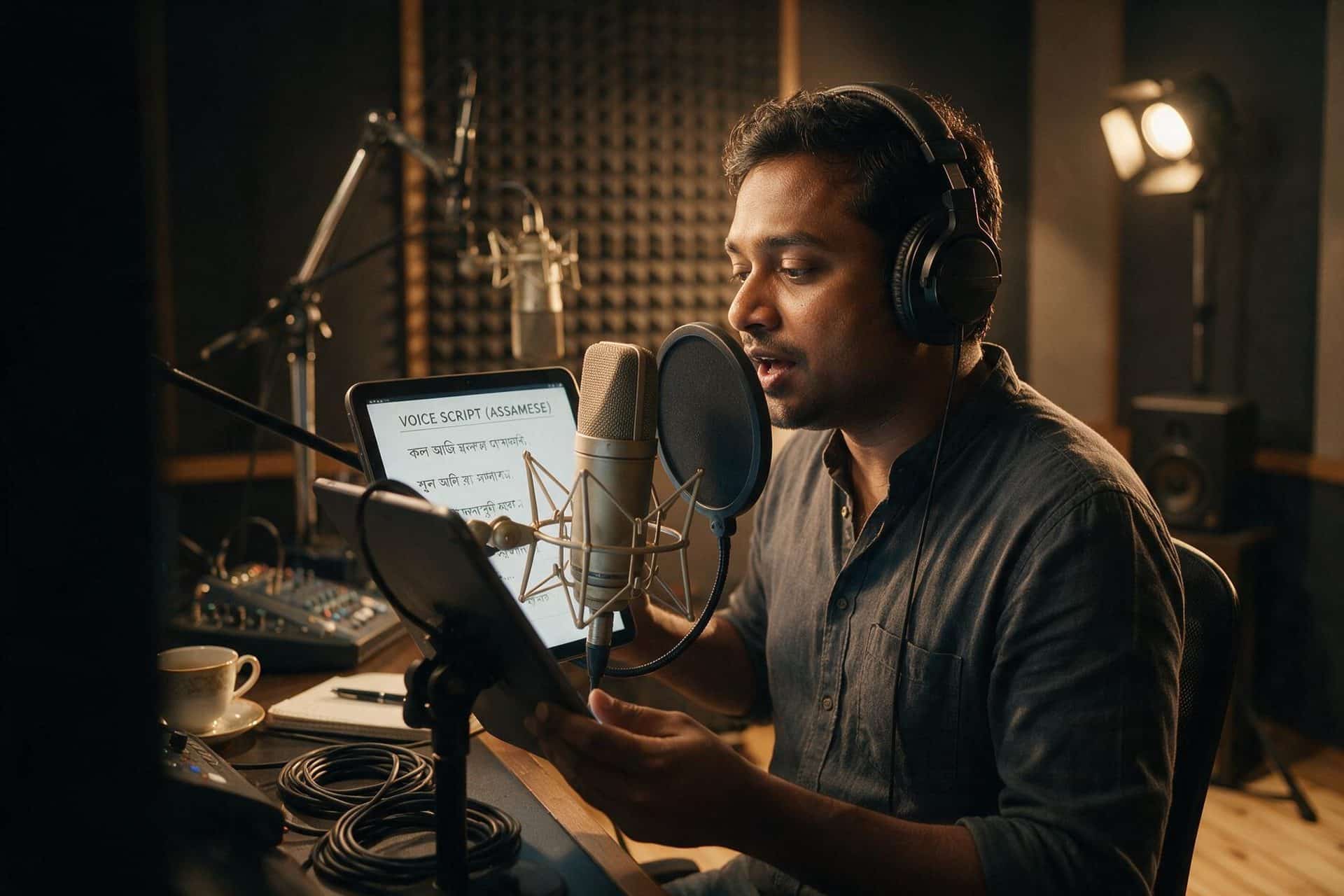
Voice Over · Filipino
Filipino voice over services
Native Filipino voice actors for corporate video, eLearning, advertising, audiobooks and more. Manila Filipino and regional accents, all recorded in broadcast-quality studios.
83M
Native speakers
170+
Languages in the Philippines
48h
Delivery
Calling Filipino voice talent
We're expanding our Filipino roster
Filipino is a language we're actively growing. If you're a Filipino voice actor, we'd love to hear your demos and put you forward for paid work.
About Filipino voice over
Find the ideal Filipino voice artist for your project
Filipino audiences are among the most online in the world, and their media mixes English into everyday speech more than almost anywhere. The craft is dialing the Taglish blend to match the brand and the moment.
We produce Filipino for consumer brands, BPO and tech, entertainment and eLearning, reaching the domestic market and a huge global diaspora, with native talent who pitch the English mix just right.
More Filipinos speak Cebuano at home than Tagalog, and a campaign that treats Filipino as covering the whole country is missing a very large audience. Filipino, the national language, is based on Tagalog and is understood almost everywhere thanks to schooling and national media — but understood is not the same as native, and in the Visayas and Mindanao a Cebuano version lands differently. If the campaign matters in those regions, tell us and we will price both rather than let you find out afterwards.
Taglish is the register of Manila media, not a lapse in standards. Advertising, broadcast and everyday urban conversation move between Filipino and English constantly, and a script written in careful pure Filipino sounds like a government announcement rather than a brand. How much English belongs depends on the audience: national campaigns aimed at urban consumers carry a great deal, public-information content aimed at rural provinces carries far less. It is a positioning decision and it should be taken deliberately.
Filipino marks respect with particles that have no English equivalent, «po» and «opo», woven into ordinary sentences when addressing anyone older or senior. Leaving them out of content that speaks to a general audience does not read as modern; it reads as rude. Putting them everywhere in youth-facing content reads as stiff. This is decided in the writing and it cannot be adjusted in the booth.
The Philippines is also the world's largest hub for English-language customer service, which means there is an unusually deep pool of Filipino voice talent with genuinely neutral English accents alongside their native Filipino. For projects that need both languages — and many do — that is a practical advantage: the same voice can often carry the English and the Filipino versions, which keeps the brand sounding like one brand.
Filipino runs longer than English on the page, so timed content needs the copy adapted rather than the read accelerated. Tell us the duration you are working to and we will tell you what has to give.
Send us the script and tell us the regions, and we will record a free casting on your own copy. If you need English as well, we will audition the same voices in both so you can hear whether one performer can carry the pair. You get an itemised quote alongside, with no obligation. Request a Filipino voice over quote, or ask us first whether your campaign genuinely needs Cebuano too — we will give you the honest answer.
Philippine English is its own established variety, used in broadcast, business and education, with its own vocabulary and its own accent — and for a great deal of content aimed at the domestic market it is the right choice rather than an American or British read. Briefs that ask for «neutral English» for the Philippines often mean this without knowing the term exists. Tell us the audience and we will recommend between Philippine English, a neutral international read and Filipino itself.
The country has well over a hundred languages, and beyond Filipino and Cebuano there are substantial audiences in Ilocano, Hiligaynon, Waray and Bicolano among others. For national public-information campaigns that matters, and for commercial work it usually does not — but it is worth asking rather than discovering afterwards that a region was addressed in a language it does not use at home.

Voice over rates
Professional Filipino voice-over recordings
From £400
/ €500 / $550
per hour in the recording studio
That hourly rate is the Basic Studio Fee: the recording session itself, studio and engineer included. Any buyout — the usage fee — is added on top and quoted separately: it depends on the markets the recording runs in, the media it runs on and how long you licence it for. Every line is itemised, and all of it carries our Price Match Promise.
Ideal for short corporate videos, IVR systems and internal communications.
- Up to 150 words
- 1 revision included
- Supplied as .wav or .mp3
- 48h turnaround
Managed from brief to delivery, for eLearning, campaign work and long-form productions.
- Any word count
- Casting + script review
- Post-production included
- Dedicated project manager
Trusted by global brands
We have used GoLocalise on a regular basis for projects in a number of languages. The service we receive is great. The team is always friendly and professional. The voiceovers we receive are of a very high quality and the turnaround is extremely quick. We are very happy to recommend GoLocalise to other businesses.

We’ve worked with the GoLocalise team on countless video projects and have always had the same consistent, great experience. Not only are they responsive and quick on turnaround, I can always trust the VO will be done right – they are always 100% clear with communication and ensure their talent is prepared to record by asking necessary questions upfront before recording. Highly recommended and will definitely work with them on future projects.

It was a pleasure to work with David and the team at GoLocalise. David gave me lots of help and advice, guiding me through my first subtitling project. He really knows his stuff! The experience was completely pain-free. I would not hesitate to recommend GoLocalise – outstanding work at a good price.

They’re reliable, adaptive and obsessed with quality. And while you can never be 100% guaranteed of perfection, you can be sure GoLocalise will go the extra mile to get it right every time. Whether that’s hiring extra resources, hopping on multiple calls or even changing their internal processes, they’ll do what it takes. We’ve worked with them now for over 5 years and we are truly thankful to have such a strong localisation partner for our business.
Looking for a Filipino voice recording? Here’s how GoLocalise can help
One project manager, start to finish
Brief review
The first pass is ours: reading the copy, checking it against the audience and flagging lines that will not survive being said aloud.
Casting
We search our Filipino voice talent database and send you a shortlist of demos in the tone you want, whether authoritative, warm, formal or energetic.
Recording & production
Once the casting is settled we handle the rest: studio booking, session direction, editing and post-production.
Delivery
The finished Filipino audio, in the format your workflow needs, when we said it would be.
One to two working days on most projects
One project manager from brief to delivery
Professional native Filipino voice actors
Broadcast-quality rooms, wherever the voice is based
Most common questions
Should we use American English or Philippine English for the Philippines?
For a domestic audience, Philippine English is usually the right answer. It is an established variety used in broadcast, business and education, with its own vocabulary and accent, and briefs asking for «neutral English» here often mean it without knowing the term. Tell us the audience and we will recommend between that, a neutral international read and Filipino itself.
Does Filipino cover the whole Philippines?
It is understood almost everywhere thanks to schooling and national media, but more people speak Cebuano at home than Tagalog, which is what Filipino is based on. Understood is not the same as native, and in the Visayas and Mindanao a Cebuano version lands differently. If those regions matter to the campaign, we would price both.
Should our Filipino script mix in English?
Almost certainly, and the question is how much. Taglish is the normal register of Manila media and advertising, and a script in careful pure Filipino reads as a government announcement rather than a brand. National urban campaigns carry a lot of English; public-information content for rural provinces carries far less. We will recommend where to sit for your audience.
Can the same voice actor record our English and Filipino versions?
Often, yes — and it is one of the practical advantages of this market. The Philippines is the world's largest hub for English-language customer service, so there is a deep pool of Filipino talent with genuinely neutral English alongside their native Filipino. We will audition the same voices in both so you can hear whether one performer carries the pair.
Should our Filipino read include English (Taglish)?
Advertising and youth content often use Taglish, while formal content stays purer Filipino, and we match your brand. Share the brief and we'll advise in the quote.
Do I need Filipino or a regional language like Cebuano or Ilocano?
It depends on your audience. Filipino, based on Manila Tagalog, is understood nationwide and is the safe default for national campaigns, advertising and eLearning. If your project is aimed specifically at Cebuano-, Ilocano- or Hiligaynon-speaking regions and you want it to feel truly local, we can cast talent in that regional language instead. We advise on the right choice for your target market before recording.
Should a Filipino voice over mix in English, or stay fully in Filipino?
It depends on the tone you're after. Code-switching between Filipino and English, known locally as “Taglish,” is extremely common in Philippine media, advertising and everyday speech, and can sound more natural and relatable for consumer brands. Formal content such as government communications, eLearning or legal material usually calls for cleaner, fully Filipino delivery. We can record either register, or a blend, depending on your brief.
Can one Filipino recording also reach Filipino communities abroad?
In most cases, yes. Standard Filipino is understood by the large Filipino diaspora in the United States, the Gulf states and elsewhere, and a neutral Manila-based read travels well internationally. If your project is aimed at a specific overseas Filipino community and you want a particular regional accent, we can cast accordingly.
How quickly can a Filipino voice over project be delivered?
Expect 24–48 hours for shorter pieces; larger scripts or busy talent schedules can extend that, so we agree the timeline with you at the outset.
How much does a Filipino voice over cost?
Every Filipino voice over is quoted individually. Recording starts from an all-inclusive Basic Studio Fee covering studio time and a sound engineer, with a usage licence added for broadcast, advertising or online campaigns. Filipino rates depend on script length, talent and how the audio is used — send your script for an exact, no-obligation quote, backed by our Price Match Promise.
Do you offer Filipino dubbing, subtitling and translation as well?
Yes. Alongside Filipino voice over we provide Filipino dubbing, subtitling and translation, so you can localise a whole project with one team. Combining services keeps terminology, tone and timing consistent across every version.
What file formats do you deliver Filipino voice overs in?
You get your Filipino audio in whatever format your workflow needs — WAV, MP3, AIFF and more — at broadcast spec, split into separate files or delivered as a single mix.
What do you need from us to quote Filipino voice over?
Less than people expect: the script, or the draft of it, its total running time or word count, where the recording will be used, and the date you need it by. If the script is not signed off yet, send the draft anyway — we would rather quote on what exists than wait for a version that eats your deadline. A named project manager comes back with an itemised quote, normally within four working hours.
How quickly will we hear back, and who will we be dealing with?
More than half of enquiries get a reply within thirty minutes during office hours (Monday to Friday, 9am to 6pm UK time), and the itemised quote normally follows within four working hours. After that you have one dedicated project manager who owns the job from brief to final file — not a ticket queue, and not a different name on every email. If it is easier, call +44 207 095 5730 and ask for them by name.
We are still pitching and the budget is not signed off. Can we still get a Filipino quote?
Yes, and it is one of the commonest reasons people get in touch. Tell us it is for a pitch and you get a figure you can put in front of your own client, itemised so it stands up to being picked apart, with no obligation and no follow-up sales calls if the pitch goes elsewhere. If it lands, the quote still holds and we already know the project.
Related services
Complete Filipino localisation
Filipino dubbing
Dubbing to picture for film and animated content
Filipino subtitling
Taglish on screen, with English spelled English
Filipino translation
Scripts, subtitles and marketing
Filipino transcription
The verb affix says who acted, even unnamed.
Tagalog translation
One spelling fixed for every English term before translation.
Ready to start your Filipino voice over project?
With the script and the brief we can put a real shortlist in front of you.
Brands that trusted us with their voice
Casting, direction and recording for campaigns that ran in several markets at once.

Voice Over · Flemish
AXA — Redefining Standards
Multilingual mastery for instructional videos: a Flemish voiceover journey.
Voice Over · Czech
Betfair
Crafting authenticity in localisation: a Czech voiceover production.
Voice Over · Cantonese
BlackBerry Worldwide
Multilingual voiceover project for BlackBerry's innovative campaign.
The complete solution to localise your content
Voice over

- State-of-the-art studios
- Neumann microphones
- On-hand sound engineers
- 1,000+ voice actors
Translation

- 100+ languages covered
- Tailored to your needs
- Stringent quality control
- Dedicated project managers
Subtitling

- Experienced subtitlers
- Industry-standard software
- Burn-in and graphic editing
- Open and closed captions
Transcription

- Improve accessibility
- Reach a wider audience
- Boost SEO and video views
- Maximise video engagement