
Voice Over · Khmer
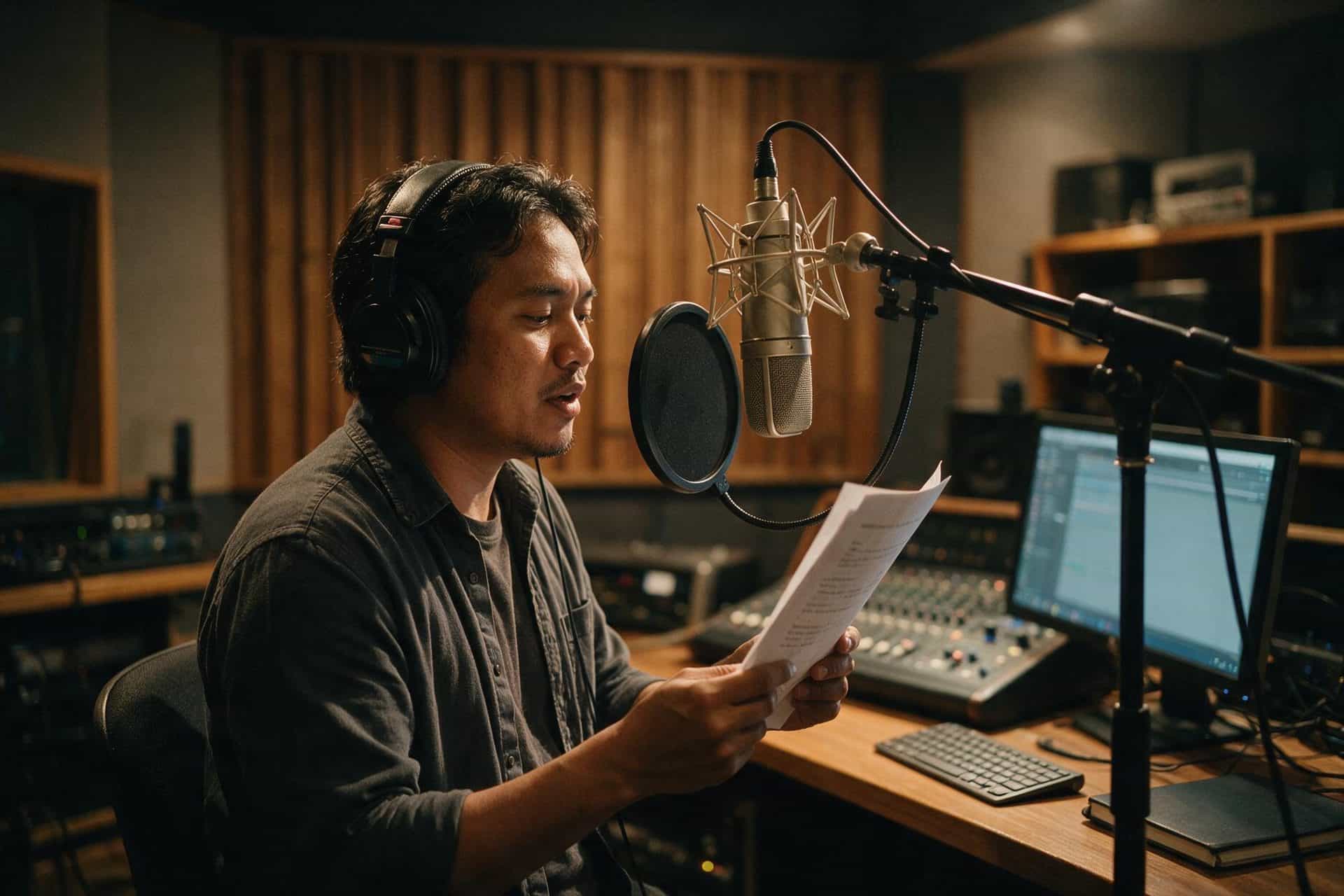
Khmer voice over services
Native Khmer voice actors for NGO, public-information, eLearning and corporate content. Unlike its neighbours Khmer isn't tonal, which leaves real room to direct the read.
0
Tones — unlike its neighbours
74
Letters, the world's longest alphabet
48h
Delivery
Calling Khmer voice talent
We're expanding our Khmer roster
Khmer is a language we're actively growing. If you're a Khmer voice actor, we'd love to hear your demos and put you forward for paid work.
About the language
Surrounded by tonal languages, and not one itself
Khmer is the official language of Cambodia and an Austroasiatic language — a different family from every one of its neighbours. Thai, Lao and Vietnamese are all tonal. Khmer is not. Pitch does not distinguish one word from another.
That is not a piece of trivia, because it changes what you can ask a voice actor for. In a tonal language, melody is already committed to meaning, and the room left for expression is narrower than producers expect. In Khmer the intonation is free to do emotional work, the way it is in English or Spanish. You can direct for warmth, urgency or intimacy without the risk of bending a word into a different one.
If you are producing across Southeast Asia at once, that is worth knowing before the sessions rather than during them: the same script needs a different kind of direction in Phnom Penh than in Bangkok or Hanoi.
The script creates the other thing worth planning for. Khmer is written without spaces between words — spaces mark the end of a phrase or clause instead. So any subtitle tool that breaks lines at the nearest space will split words in half, and the result is barely readable to a native. Line breaks in Khmer have to follow meaning, not characters, which is human work rather than an algorithm's. Khmer also holds the record for the world's longest alphabet at 74 letters, though that changes nobody's project.
Typical work is NGO and development communications, public-health and demining awareness, eLearning, tourism and heritage content, corporate video and garment-sector training, plus broadcast and documentary narration.
Before anything is booked, let us read what you have written. Free review, itemised quote, and a clear answer on anything you are unsure about. You also get a free casting: shortlisted Khmer voices reading your own copy, with no obligation to book any of them. Request Khmer auditions, or outline what you are planning and we will come back with options.
Getting Khmer right
The decisions that come before the read
One thing gives you more freedom than you expect, and one will quietly wreck your subtitles.
No tones means real direction
Because pitch does not carry meaning, intonation is available for expression. You can ask for warmer, calmer or more urgent and actually get it, which is not true of Thai or Vietnamese in the same way.
Subtitles cannot break on spaces
Khmer writes without spaces between words; spaces end phrases. Automated line-breaking splits words in half. Line breaks have to be placed by someone who reads the language.
Register follows social hierarchy
Khmer has distinct vocabulary depending on who is being addressed — monks, officials, peers. Tell us the audience and the setting and we pitch the register accordingly.
Not a Thai dialect
Khmer is Austroasiatic and Thai is Tai-Kadai — different families entirely. They share vocabulary and script ancestry through historical contact, not descent. We cast native Khmer speakers.
How we can help
One partner for the whole Cambodia job
Voice over & narration
Native Khmer for NGO and public-information content, eLearning, tourism, corporate video and IVR, directed for register and tone.
Translation & script adaptation
Khmer translation by native linguists, with the register pitched for the audience rather than by default.
Subtitling & captions
Khmer subtitles with line breaks placed by a native reader, so words are not split mid-way.
100+ languages under one roof
London studios + global talent network
5.0★ from 149 reviews
Content types
Khmer voice over for every kind of content
Whatever you're making, we cast the right voice in Khmer. Explore by use case.
Most common questions
Is Khmer a tonal language?
No, and it is the exception in its region — Thai, Lao and Vietnamese all are, and Khmer is not. Practically, that means intonation is free to carry emotion rather than meaning, so there is genuine room to direct a read for warmth, urgency or intimacy. If you are producing across Southeast Asia, expect the Khmer session to feel more like directing English than the others.
Why do our Khmer subtitles look wrong at the line breaks?
Because Khmer is written without spaces between words — spaces mark the end of a phrase instead. Any tool that breaks lines at the nearest space will cut words in half, which is hard to read for a native even though it looks fine to anyone who does not read the script. Line breaks have to be placed by someone who reads Khmer, and we do that as part of the subtitle work.
Can a Thai voice actor cover Khmer?
No. Khmer is Austroasiatic and Thai is Tai-Kadai — separate language families. They share a good deal of vocabulary and their scripts have a common ancestor, but that comes from centuries of contact rather than from being related, and they are not mutually intelligible. We cast native Khmer speakers.
Does the audience change the register?
Yes, more than in most languages we work with. Khmer uses different vocabulary depending on social relationship — addressing monks, officials or peers are genuinely different registers rather than tone-of-voice choices. Tell us who the content speaks to and in what setting, and we pitch it correctly from the translation stage.
Can you translate our script into Khmer?
Yes, with native Khmer linguists. For NGO and public-health material we would suggest settling terminology up front, and we would keep the translation and the subtitling together so the same person handles wording and line breaks.
Will our English timings still work in Khmer?
Usually close, with some room needed. Khmer does not expand against English as sharply as the Bantu languages do, but it is rarely shorter. We flag anything tight at translation stage so the read does not have to be rushed to fit.
What do you use Khmer voice over for?
NGO and development communications, public-health and demining awareness campaigns, eLearning and workplace training including the garment sector, tourism and heritage content, corporate video, documentary narration and broadcast material.
How long does a recording take to arrive?
Most short Khmer projects are delivered within 24 to 48 hours; longer or multi-voice work is scheduled with your dedicated project manager, who confirms a firm date up front. The time difference is handled at our end.
What audio specification will we receive?
Whatever the platform takes for your Khmer files: WAV, MP3 or separated stems, mastered to the loudness figure you give us.
What do you need from us to quote Khmer voice over?
Less than people expect: the script, or the draft of it, its total running time or word count, where the recording will be used, and the date you need it by. If the script is not signed off yet, send the draft anyway — we would rather quote on what exists than wait for a version that eats your deadline. A named project manager comes back with an itemised quote, normally within four working hours.
How quickly will we hear back, and who will we be dealing with?
More than half of enquiries get a reply within thirty minutes during office hours (Monday to Friday, 9am to 6pm UK time), and the itemised quote normally follows within four working hours. After that you have one dedicated project manager who owns the job from brief to final file — not a ticket queue, and not a different name on every email. If it is easier, call +44 207 095 5730 and ask for them by name.
We are still pitching and the budget is not signed off. Can we still get a Khmer quote?
Yes, and it is one of the commonest reasons people get in touch. Tell us it is for a pitch and you get a figure you can put in front of your own client, itemised so it stands up to being picked apart, with no obligation and no follow-up sales calls if the pitch goes elsewhere. If it lands, the quote still holds and we already know the project.
Brands that trusted us with their voice
Casting, direction and recording for campaigns that ran in several markets at once.

Voice Over · Flemish
AXA — Redefining Standards
Multilingual mastery for instructional videos: a Flemish voiceover journey.

Voice Over · Czech
Betfair
Crafting authenticity in localisation: a Czech voiceover production.

Voice Over · Cantonese
BlackBerry Worldwide
Multilingual voiceover project for BlackBerry's innovative campaign.
Complete your Southeast Asia coverage
Services that pair with Khmer
Thai voice over
The tonal neighbour, and a different language family.
Vietnamese voice over
Usually localised in the same regional push.
Khmer subtitling
Stacked Khmer glyphs need a taller subtitle box.
Khmer transcription
Respect is a different word, not a different tone.
Khmer translation
The right words for monks and royalty, set at the brief.
From £400
/ €500 / $550
per hour in the recording studio
That hourly rate is the Basic Studio Fee: the recording session itself, with the voice actor, the casting, the direction, the studio and the engineer included. Any buyout — the usage fee — is added on top and quoted separately: it depends on the markets the recording runs in, the media it runs on and how long you licence it for. Every line is itemised, and all of it carries our Price Match Promise.
Sound Khmer to a Cambodian audience
Tell us what the project is and we will cast for it, with a free quote and no obligation attached.
The complete solution to localise your content
Voice over

- State-of-the-art studios
- Neumann microphones
- On-hand sound engineers
- 1,000+ voice actors
Translation

- 100+ languages covered
- Tailored to your needs
- Stringent quality control
- Dedicated project managers
Subtitling

- Experienced subtitlers
- Industry-standard software
- Burn-in and graphic editing
- Open and closed captions
Transcription

- Improve accessibility
- Reach a wider audience
- Boost SEO and video views
- Maximise video engagement