
Voice Over · Galician
Galician voice over services
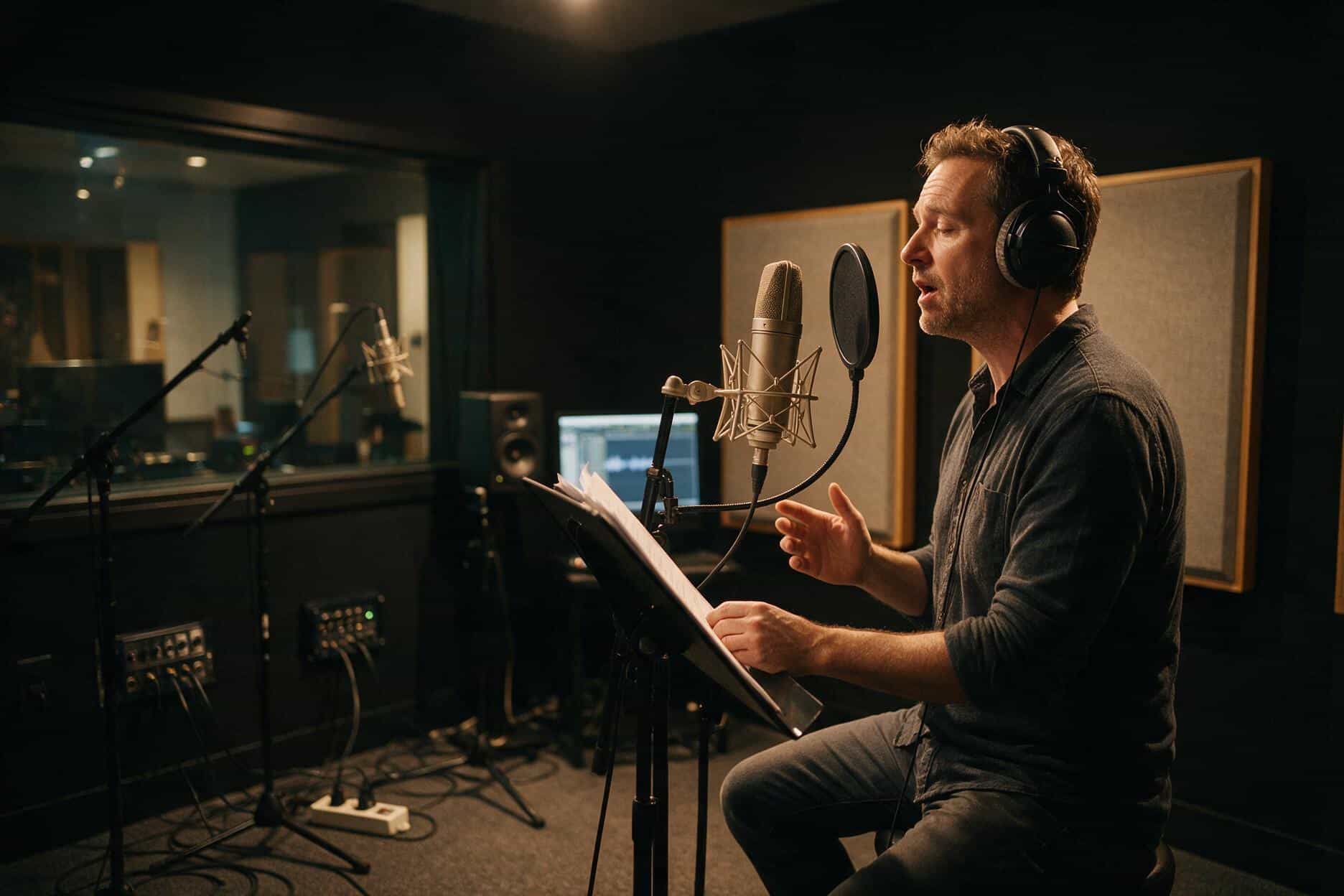
Native Galician voice over for institutional and public-information content, broadcast, corporate video and cultural material. Related to Portuguese, and audibly not the same thing — a Lisbon read is understood in Galicia and heard as foreign.
Shared
Medieval origin with Portuguese
RAG
Sets the written standard
48h
Delivery
Calling Galician voice talent
We're expanding our Galician roster
Galician is a language we're actively growing. If you're a Galician voice actor, we'd love to hear your demos and put you forward for paid work.
About the language
Yes, it's close to Portuguese. No, a Portuguese voice won't do.
This is the question on almost every Galician brief, and it comes from something true. Galician and Portuguese share an origin — medieval Galician-Portuguese — and a Galician reader follows written Portuguese with little difficulty. From the page, they look like close cousins.
From the speaker, they are not. The phonetics diverged sharply. European Portuguese reduces and elides its unstressed vowels to a degree Galician does not share; Galician keeps a vowel system much closer to Spanish. That single difference is enough that a Lisbon read is placed as Portuguese within a sentence — understood, and audibly from somewhere else.
There are also markers that belong to Galician and to nowhere else. Gheada — the «g» realised as an aspirate across much of western Galicia — and seseo are the most recognisable. Both are regional features inside Galicia rather than part of the standard, which is where the second casting decision comes in.
That decision is standard or regional. The normative standard set by the Real Academia Galega is what administration, education and the public broadcaster CRTVG use, and it is what any institutional or public-facing piece should be recorded in. Gheada and seseo belong to specific areas and work for character, fiction or a deliberately local campaign — in a government announcement they read as regional colour rather than as authority.
Typical work is institutional and public-information campaigns, broadcast and documentary, health and education material, museum and cultural interpretation, corporate video for companies operating in Galicia, and eLearning delivered bilingually.
The cheapest place to fix a problem is the page, not the booth. Reviewing it costs nothing. You get the notes, the quote itemised, and no pressure attached to either. We record a free casting as a matter of course. Hearing Galician voices on your lines settles in a minute what a demo reel never will. Start a Galician voice over quote, or send a rough outline and we will fill in the gaps.
Getting Galician right
What to decide before recording
Two decisions, and the first one is the reason most people find this page.
Portuguese is close and audibly different
Shared origin, diverged phonetics. European Portuguese reduces unstressed vowels far more; Galician's vowel system sits nearer Spanish. Listeners place it immediately.
Standard for anything institutional
The Real Academia Galega norm is what administration, schools and CRTVG use. It is what public-facing content should sound like.
Gheada and seseo are regional
Strong, recognisable markers from specific areas. Right for character and local campaigns, wrong for a national institutional read.
Usually one half of a pair
Galician is co-official with Spanish, so much of this work ships alongside a Spanish version. Commissioning both together keeps the timings aligned.
How we can help
One partner for the whole Galicia job
Voice over & narration
Native Galician for institutional and public-information content, broadcast and documentary, cultural interpretation and corporate video — in the standard or a regional read, as the brief requires.
Translation & script adaptation
Galician adaptation by native linguists, not Portuguese or Spanish copy lightly adjusted. If the piece ships bilingually, we build the pair together.
Subtitling & captions
Galician subtitles and captions alongside the recording, so the on-screen text matches the read.
100+ languages under one roof
London studios + global talent network
5.0★ from 149 reviews
Content types
Galician voice over for every kind of content
Whatever you're making, we cast the right voice in Galician. Explore by use case.
Most common questions
Can a Portuguese voice actor cover Galician?
No, though the question is a fair one. Galician and Portuguese share a medieval origin and a Galician reader follows written Portuguese comfortably. But the phonetics diverged: European Portuguese reduces and elides unstressed vowels far more than Galician does, and Galician's vowel system sits much closer to Spanish. A listener in Galicia places a Lisbon read as Portuguese within a sentence. Understood, and clearly from somewhere else.
Should we record in the standard or with gheada and seseo?
The standard, for anything institutional or public-facing. The norm set by the Real Academia Galega is what administration, education and the CRTVG broadcaster use, and it is what audiences expect from that kind of content. Gheada and seseo are strong regional markers from specific parts of Galicia — excellent for character work, fiction or a deliberately local campaign, and out of place in a government announcement.
Can a Spanish voice actor cover Galician?
No. Galician is a separate Romance language, not an accent of Spanish, and while nearly all Galician speakers are bilingual that is a fact about people rather than about the languages. A Spanish read is immediately recognisable as Spanish. If your content ships in both, we record each with its own native talent and can schedule the sessions together.
Do you deliver the Spanish version alongside it?
Yes, and it is usually the sensible way to do it. Galician is co-official with Spanish in Galicia, so most of the work we see is one half of a bilingual deliverable. Commissioning the pair together lets us adapt both to the same picture, keep the sync points aligned and hold terminology consistent, and it generally costs less than treating them as separate projects.
How big is your Galician roster?
Small — one voice on the books at the moment, and we are actively recruiting. We would rather tell you now than at shortlist stage. In practice we treat every Galician brief as a casting job: you give us the register and the audience, we go to our wider network in Galicia, and we come back with bespoke auditions.
Do you have male Galician voices?
Not on the roster at the moment — our current Galician voice is female. If your project needs a male read, say so when you brief us and we will go to our wider network and come back honestly about what we can arrange and in what timeframe.
Can I direct the session remotely?
Yes, and for Galician that is the arrangement — our talent records through our global network rather than in our London studios. You can direct live over Source-Connect, Zoom or Teams, so you hear takes as they happen and can adjust on the spot.
What do you use Galician voice over for?
Institutional and public-information campaigns, broadcast and documentary narration, health and education material, museum and cultural interpretation, corporate video for companies operating in Galicia, eLearning delivered bilingually, and accessibility work such as audio description.
How are the finished files delivered?
For Galician as for anything else, the spec sheet governs rather than our habits — WAV or MP3, stems on request, at whatever sample rate, bit depth and loudness is written down.
What do you need from us to quote Galician voice over?
Less than people expect: the script, or the draft of it, its total running time or word count, where the recording will be used, and the date you need it by. If the script is not signed off yet, send the draft anyway — we would rather quote on what exists than wait for a version that eats your deadline. A named project manager comes back with an itemised quote, normally within four working hours.
How quickly will we hear back, and who will we be dealing with?
More than half of enquiries get a reply within thirty minutes during office hours (Monday to Friday, 9am to 6pm UK time), and the itemised quote normally follows within four working hours. After that you have one dedicated project manager who owns the job from brief to final file — not a ticket queue, and not a different name on every email. If it is easier, call +44 207 095 5730 and ask for them by name.
We are still pitching and the budget is not signed off. Can we still get a Galician quote?
Yes, and it is one of the commonest reasons people get in touch. Tell us it is for a pitch and you get a figure you can put in front of your own client, itemised so it stands up to being picked apart, with no obligation and no follow-up sales calls if the pitch goes elsewhere. If it lands, the quote still holds and we already know the project.
Brands that trusted us with their voice
Casting, direction and recording for campaigns that ran in several markets at once.

Voice Over · Flemish
AXA — Redefining Standards
Multilingual mastery for instructional videos: a Flemish voiceover journey.
Voice Over · Czech
Betfair
Crafting authenticity in localisation: a Czech voiceover production.
Voice Over · Cantonese
BlackBerry Worldwide
Multilingual voiceover project for BlackBerry's innovative campaign.
Complete your Iberian coverage
Services that pair with Galician
Portuguese European voice over
The close relative — and not a substitute.
Spanish voice over
The other half of most Galician deliverables.
Translation services
Galician adaptation by native linguists.
Galician subtitling
Two orthographies, and the letters themselves change.
Galician transcription
Verbatim or clean-read transcripts of audio and video.
Galician translation
English tenses rebuilt the Galician way, not copied across.
From £400
/ €500 / $550
per hour in the recording studio
That hourly rate is the Basic Studio Fee: the recording session itself, with the voice actor, the casting, the direction, the studio and the engineer included. Any buyout — the usage fee — is added on top and quoted separately: it depends on the markets the recording runs in, the media it runs on and how long you licence it for. Every line is itemised, and all of it carries our Price Match Promise.
Galician that sounds like Galicia, not like Lisbon
Tell us the register and whether a Spanish version ships with it — with a free, no-obligation quote.
The complete solution to localise your content
Voice over

- State-of-the-art studios
- Neumann microphones
- On-hand sound engineers
- 1,000+ voice actors
Translation

- 100+ languages covered
- Tailored to your needs
- Stringent quality control
- Dedicated project managers
Subtitling

- Experienced subtitlers
- Industry-standard software
- Burn-in and graphic editing
- Open and closed captions
Transcription

- Improve accessibility
- Reach a wider audience
- Boost SEO and video views
- Maximise video engagement